

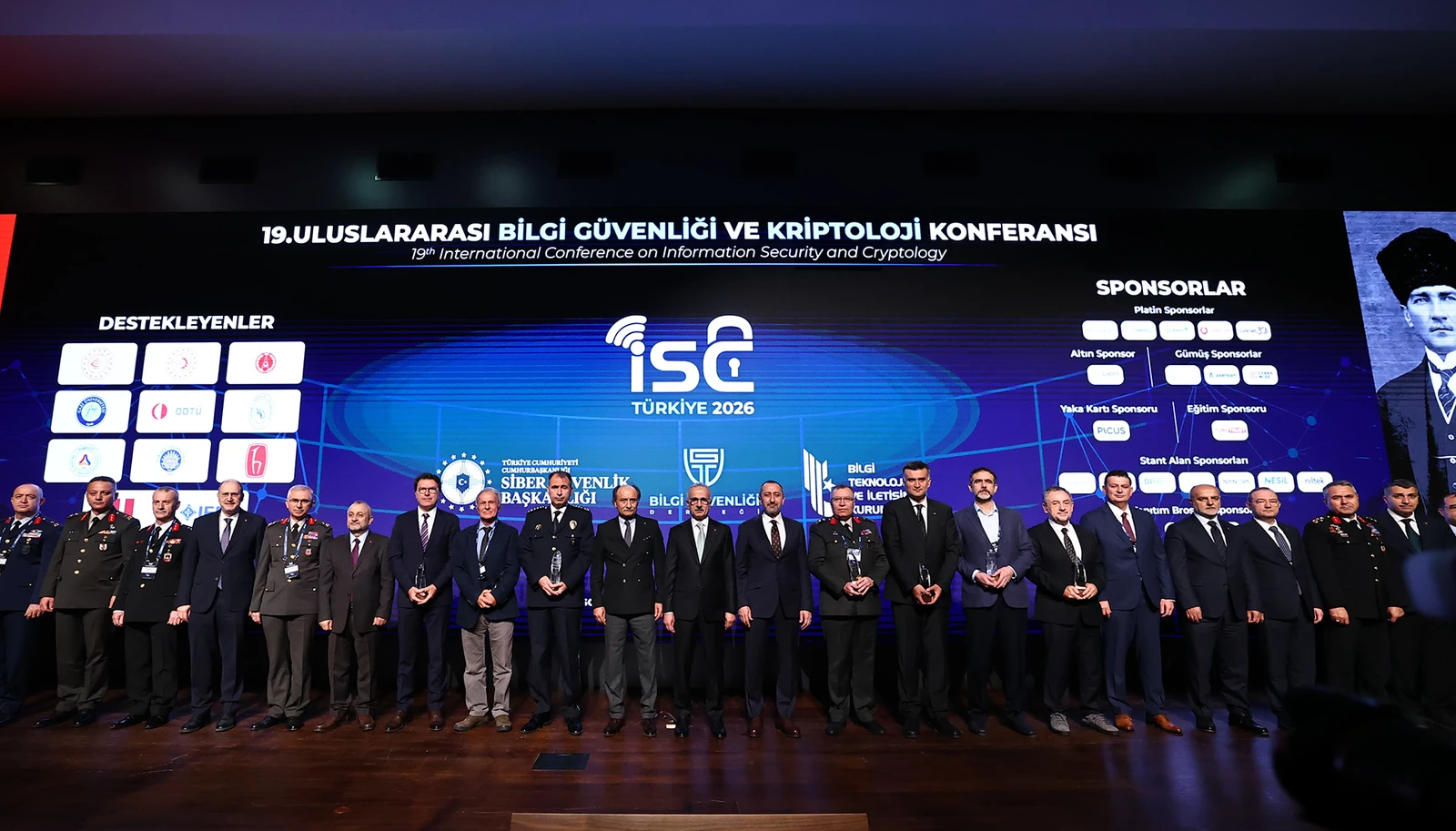
The International Information Security and Cryptology Conference, organized by the Information Security Association, was hosted by the Information and Communications Technology Authority. The program addressed topics such as the role of artificial intelligence in cyber defense, critical infrastructure security, national cryptology strategies, and data privacy.
Held for the 19th time this year, the conference brought together decision-makers, academics, industry professionals, and young talent in the field of cybersecurity under a shared vision. Transportation and Infrastructure Minister Abdulkadir Uraloğlu, who attended the opening ceremony, made remarks regarding Turkey’s cybersecurity capabilities, security measures for its communications infrastructure, and the protection of children in the digital environment.
Stating that the most valuable treasure of the information age is cybersecurity software and technologies, Minister Uraloğlu said, “Data is no longer just a pile of archived information; it is the raw material of production, the shield of security, the engine of the economy, and the foundation of sovereignty. “The question of where this data is hosted, under what standards it is processed, and who controls it is no longer merely a technological issue; it is also a strategic, economic, and national issue. Undoubtedly, the countries that establish sovereignty over data will be the winners of tomorrow,” he said.
Minister Uraloğlu: We Are Expanding Turkey’s Digital Security Map
Noting that cybersecurity is of critical importance for both Turkey and the international community, Uraloğlu highlighted the importance of data centers in terms of digital security and technological independence, saying, “We are expanding Turkey’s digital security map step by step.”
Uraloğlu also highlighted Turkey’s achievements in the field of cybersecurity. Referring to the impact of the establishment of the Cybersecurity Presidency on cybersecurity efforts, Uraloğlu stated, “This is a concrete manifestation of our country’s determination to protect its national interests in the cyber world.”
Minister Uraloğlu also addressed initiatives related to the telecommunications sector in his speech. Recalling that the Information and Communications Technologies Authority (BTK) meticulously carries out regulatory, supervisory, and oversight activities in the electronic communications, postal, and electronic trust services sectors, Uraloğlu said, “The Board Decision adopted this year, which requires all authorized operators—regardless of their economic size—to implement additional security measures, is an important step toward raising the sector’s security level and enhancing the cyber resilience of our infrastructure,” he remarked.
Minister Uraloğlu: Our Children Are the Ones We Must Protect Most in the Digital World
Uraloğlu also noted that measures such as restricting the provision of social media services to those under 15 and implementing age verification systems have been put into effect to protect children from the risks of the digital environment, adding, “In the digital world, our children are the ones we must protect the most. The provision of social media services to children under the age of 15 has been restricted. Prioritizing the healthy development of our children, standing by our families, and ensuring that platforms assume greater responsibility are an integral part of our national security philosophy,” he stated.
SGB President Önal: Data Is Not Merely a Technical Element
Presidential Cyber Security Chief Ümit Önal also delivered a speech during the program highlighting the importance of cyber security. Noting that the powerful nations of the future will be those capable of managing technology according to their own will, Önal discussed the cyberattacks that have occurred around the world in recent times. Önal said, “In France, attackers infiltrated hundreds of refrigeration systems at several supermarket chains and disrupted the cold chain by remotely altering the temperature settings of the refrigerators. There was no locked screen, no ransom, no ransomware, and no ransom note. There was simply a remote, silent intervention in a country’s food supply chain. This is no longer just a matter of computer security—it has become a matter of food security,” he said.
Noting that Turkey has taken significant steps toward digital sovereignty, Önal said, “The Cybersecurity Council has prioritized the protection of critical infrastructure and capacity building using domestic and national technologies.” At the same meeting, data sovereignty was discussed as a separate agenda item. It was emphasized that data is not merely a technical element but a strategic asset. In other words, what is now being discussed is no longer a matter of technological preference but has become a matter of state policy. The scope of the Cybersecurity Presidency’s responsibilities has been expanded to include the digital government sector. Authorities regarding artificial intelligence applications in the public sector have also been consolidated under the Cybersecurity Presidency. This means that cybersecurity, digital transformation, and artificial intelligence are being discussed at the same table, rather than at separate ones,” he said.
SGB President Önal: No System Is 100 Percent Secure
Pointing out the necessity of sharing threat intelligence, conducting joint exercises, and establishing a rapid flow of information, Önal said, “No system is 100 percent secure; we know this. The question isn’t ‘Will we be attacked?’—we definitely will be. The real question should be: How quickly will we recover once we’re attacked? We must invest not only in prevention but also in detection, response, and recovery capabilities. Redundancy, crisis drills, zero-trust architecture, and post-quantum encryption plans are no longer a luxury—they are a necessity,” he said.
BTK Chairman Koçyiğit: We Have Taken Additional Security Measures to Ensure the Secure Growth of the Communications Infrastructure
BTK Chairman Mehmet Koçyiğit, in his speech, highlighted the contributions of the agency’s ongoing efforts to cybersecurity. Noting that, according to the Cybersecurity Agency’s report, the public sector is the most frequently targeted sector, Koçyiğit noted that the cyber infrastructure has also been strengthened through reinforcement efforts in the fields of communications and infrastructure.
Recalling that they have implemented additional security measures to ensure the secure growth of the communications infrastructure, Koçyiğit stated, “We have made our additional security measures mandatory for all our operators, regardless of their net sales figures. Based on the lessons learned from the February 6 earthquakes, we have imposed an obligation on our operators in the 5G licensing process to maintain a communication capability that can rapidly reach the field during a disaster. In addition, we have required our operators to keep 450 mobile base stations ready that can operate via satellite connection in the event of emergencies by the end of five years,” he shared.
Koçyiğit also commented on the MILCOM 2026 event they attended in Washington, “The detection of electronic jamming using artificial intelligence, positioning via low-Earth orbit satellites in environments where GPS signals are jammed, and encryption resistant to quantum computers were the most discussed topics at the conference. Our country is not merely a spectator in this race. Today, I am proud to state that the National Monitoring System, which we developed in collaboration with ASELSAN, monitors our frequencies day and night and detects unauthorized transmissions without the need for a report. “Our interference-based positioning technology is one of the most advanced systems in the world. Fergani Space is launching our national satellites into space one after another for the Uluğ Bey Global Positioning System,” he said, highlighting these domestic and national initiatives.
BTK Chairman Koçyiğit: Devices Operating on Our Network Are Now a Matter of Sovereignty
Pointing out the need for domestic and national production to become widespread in every field, Koçyiğit said, “Which devices operate on our network is now a matter of sovereignty. For this reason, we have mandated that the proportion of domestically produced goods in 5G be gradually increased to 60 percent, and the proportion of National Telecommunications Products to 15 percent. With the Board Decision we adopted in September, we also decided that new base stations to be established in settlements with a population under 5,000, as well as along routes such as highways, high-speed rail lines, and tunnels, must be procured from products that meet the definition of ‘National Telecommunications Products.’”
Koçyiğit addressed the students, saying, “We are here for you with our free artificial intelligence training courses at BTK Academy, which now number 75. Be curious, ask questions, and don’t be afraid to make mistakes. Our country needs your knowledge and energy,” he said, concluding his remarks.